
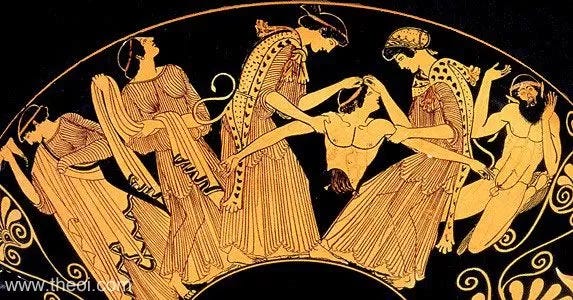
The Death of Pentheus, Attic Red Figure Kylix attributed to Dourix, c.480 BCE | Kimball Art Museum, Fort Worth
This lecture of Louise’s was curated from The Cowan Archives and portions were delivered to students enrolled in the online class Louise Cowan on Greek Tragedy. It was likely originally written for undergraduate students at the University of Dallas. If you would like to enroll in a future online class through the Cowan Center, please email: cowanarchive@udallas.edu to be added to the mailing list. Future events will also be announced through Substack.
If Prometheus Bound marks the beginning of Greek tragedy (not in the date on which it was produced, since it was produced at the end of Aeschylus’ life, but in its image of the tragic cosmos), then The Bacchae marks the end of this flowering of an art form that has set the pattern for human achievement. And as Prometheus Bound was about an offense against a god, about suffering, a sight that hurts the eye, the singling out of a victim in isolation, a mountainous region, the cruelty of a god, the raising up and hurling down of the protagonist (a kind of crucifixion), the conflict between two kinds of knowledge, sacrifice for the good of the city, so also is The Bacchae about these elements of tragedy. Indeed, we could say that most of the 32 surviving Greek tragedies are in some sense about the sacrificial crisis—that violence, as Rene Girard speaks of it, which is required to found and then to maintain the city.
Eighteen of those 32 surviving plays were written by Euripides, seven by Aeschylus, and seven by Sophocles, both of whom produced far more than Euripides. Euripides was an extremely popular playwright, even though his dramas were controversial and shocking. You will encounter a burlesque of him in Aristophanes’ Acharnians and Frogs. He was satirized for his low style, his inclusion of domestic detail, and his refusal to elevate the matter of his tragedies.
And such controversy about him has continued up to the present day. Nietzsche charged that Euripides (along with Socrates) struck the death blow to tragedy, that he was a rationalist and a skeptic. Other critics have seen Euripides as reducing the essentially metaphysical issues in tragedy to psychological ones; some say he is a determinist; some call him a misanthrope, an atheist, and—worst of all in our time—a misogynist, a charge that is patently unfair because of his manifestly sympathetic treatment of women and their problems (Medea, Electra, Iphigenia, Clytemnestra, The Trojan Women, Phaedra). Most have considered him, as Aristophanes does, a lesser dramatist than the other two. Recently, however, a new wave of literary critics has been vindicating his artistry.
Some of the most influential of modern critics have illuminated the complexity and “savage freshness” of this play: W. K. C. Guthrie (The Greeks and Their Gods, 1955), E. R. Dodds (The Bacchae, 1963), and R. P. Winnington-Ingram (Euripides and Dionysos, 1969), a brilliant book about this single play. These and other authors have shown, as Robert Bagg has written, “that the forces Dionysus wields are real, forces that no man in any age can afford to ignore: a source of supreme joy and a danger as destructive as any in life.”
“What then is The Bacchae?” asks Siegfried Melchinger. “It is the tragedy of tragedies,” he claims. It brings out into the open and examines the old myths that were the stuff of the theater in older times, using the archaic arena, the costumes and forms that were familiar. Gilbert Murray said that it is bound more tightly by form than any Hellenic play we know. It brings together everything the models of previous tragedy contributed and distills out of them what remained relevant to its own day. It is the essence of the human condition as Euripides saw it in 406 BC, after looking back over a long lifetime.
Dionysus is not the anti-Apollo that Nietzsche considered him to be. He is in the center between the opposite poles, not the god of metamorphoses, but the god of dichotomy. He is in the middle between man and woman, between Asia and Europe, between Hellas and the barbarian world, between heaven and hell (according to Heraclitus, his other name is Hades), between death and life, between raving and peace (mania and hesychia).
Dionysus is the one who disappears and returns, hunter and hunted, murderer and victim, life and death. The tragedy consists in knowing that these two aspects are different sides of the same manifestation.
Goethe considered The Bacchae to be Euripides’ most beautiful tragedy. In his last years he was preparing to translate it into his own beloved German language, but death overtook him before he could do it.
But the task you and I have in reading these tragedies that come to us from another continent and another epoch, so far away in time and space as to be virtually inaccessible as history—the task is to appropriate them, to grasp them (and that means to experience them, to approach them with the willing suspension of disbelief, and hence not so much to absorb them as to be absorbed), to go on to a few mappings without, however, thinking that we are getting at the final meaning. Nor, without a lifetime of study as a classical scholar, should we think we are approaching the original meaning (what the Greeks thought of them, or what their significance was in their own culture).
As serious readers of literature, as disseminators of the literary tradition, we have no hope of apprehending these Greek dramas except in the light of their universal qualities. It is the miracle of the work of art that it speaks across the ages: that, in fact, we know in principle that we may see more in it than those of the culture out of which it came.
The work of art has its own world: that world is not cut off from the daily world in which we live, but it does not relate to it in any literal fashion. It is as works of art, then, that these tragedies must be seen; and that act the act of seeing truly and clearly what is there is difficult enough. We know that we have to start with the whole thing: what is it, what is it doing? For the details of a work of art (its characters, its other elements of structure, its style, its visual aspects, its music) are radically affected by the whole of which they are a part. Someone who laughs at a funeral is different from someone who laughs at a festival. The act of laughing may be the same, but its significance hardly is. It turns out to be important, then, in evaluating the person who laughs to know whether he is at a funeral or a festival. The “world” of the work is the first and most important determinant: the totality of what is rendered: what is it?
So, though most of the authorities writing on the Bacchae concern themselves with important aspects of it: the character of Dionysus and of Pentheus; the sacrificial pattern of action—the pompos, the agon, the komos—what we have to be willing to do in this liminal time of study together is to try to see what the Bacchae is in the universal experience, in our own psyches.
We need to enter its world, not judging it, not doubting it, but trying to have the experience and then, after contemplating it, to understand.
The play is, of course about the Dionysian ecstasy: that force in life that is the source of all things. But in the way it is presented here, that ecstasy represents the very current of life, not a special liturgy or orgy: what is symbolized is the narrowing of the mind, the hardening of the heart that constitutes a rejection of life. Everything in the play is a vehicle for the expression of that fatal pride (in a mysterious way, the Greek tragedies all seem to show us that the ruler of a city does indeed represent his people—they are stained with his guilt and are cleansed by his expiation).
The Bacchae was composed at the same time as Oedipus at Colonus, and as many have pointed out, constitutes the final keystone of the arch of the tragic drama. It seems to present an entirely different view of life from Sophocles’ play: which sees the gods as merciful and forgiving, whereas, as many point out, the Bacchae shows them as vindictive and merciless. But such a simplistic view hardly seems fair. We have to try to see the Bacchae for what it is: it is not a play about the gods in general: it is a play about a particular god a particular power that makes up an aspect of being. And it is not about what happens to the good man after long years of suffering, as Sophocles drama is: it is about the proud man, the pretentious man, the pompous man who persists in refusing to accept anything beyond his own narrow views: it is about a city that has rejected its own, that will not believe in the sacred in its own midst: it is a vision of the doomed city, led by the doomed ruler: it is a vision of that hardening of the heart that one feels as an ever present possibility in life.
We have heard from our other lectures that Thebes is the image in Greek culture of the wicked city, the doomed city. Its origin and its history confirm its stiff-necked quality, its attitude, apparently shared by most of its citizens, of unyielding pride. It is like the doomed cities of the Biblical tradition: Sodom and Gomorrah, Nineveh and perhaps even Babylon. In contrast to the beloved city (the city made up of people) is the harsh city of Babylon (the city made up of material things) these two cities are carried as concepts throughout Scripture, on up to the Apocalypse in the New Testament, where the two are seen coming down from heaven one the bride, the other the harlot. Symbolically speaking, we might take Athens and Thebes as such images for the Greeks. It is not, then, that Thebes is fated to be destroyed, but that it chooses its own destruction over and over gain. “That way you shall forever keep the city/ Safe from the men of Thebes, the dragons’ sons,” says Oedipus in Oedipus at Colonus.
The power of the Bacchae, then, is that it gives us that archetypal Day of Wrath, the day when the divine comes in judgment, when all is required of the city and the individual soul, and they are found wanting. It is a terrifying study of the rationalist, skeptical mind in confrontation with mystery, depicting a city that has moved away from its myth and has allowed that myth to harden into a rigid moral structure. It is a glimpse of the Puritan mind that refuses to accept the wholeness of existence. We see the city that, like our modern society, is suffering from the abstraction that civilization brings to a people, a city that rejects its opportunity to renew itself in the god.
Recognizing, then, that the play is an enactment of the terrible hubris of final impenitence, we can turn to its parts and attempt to see it in more detail. Our troubling thoughts about the vindictiveness of the god should then be taken care of; our horror at the final magnificent image of Agave carrying in her son’s severed head—his mask—should be made bearable. This is not an ordinary situation in an ordinary city. Pentheus does not represent the ordinary homme moyen sensuel. It is at a particular stage in his life, a stage that represents and is fair to the whole of his life. He acts out his rejection before us—and in the process represents his entire city.
Cowan Center Events
Myths and Meaning, CiRCE Institute April 16-17. Mandi Gerth presents a lecture discussing Donald and Louise Cowan’s views on Modern Myth in support of a forthcoming collection of essays from the Cowan Archives published by CiRCE Press.
Distinguished Lecture Series, University of Dallas April 23 6:00 PM. The Center relaunches its Distinguished Lecture Series by hosting author and UD alumnus, Dr. Jason M. Baxter. Dr. Baxter will deliver a lecture entitled, “Deep Reading in the Age of Hypertexts.” Drawing upon his recent book, Why Literature Still Matters, Dr. Baxter will make the case that in our age of technology, literature is not just still relevant but urgent. Tickets are free, but advanced registration is required.
Cowan Archive Unbound is a publication of the Cowan Center. We are committed to bringing you writing inspired by Donald and Louise Cowan including documents culled from The Cowan Archive housed by the Cowan-Blakley Library at The University of Dallas. Tax-deductible donations can be made to the Cowan Center through the University of Dallas.